

The TryHackMe Eradication & Remediation Room is a subscriber only room that is part of the SOC Level 2 Learning Path. It has both theory and practical parts. The room can be found at: https://tryhackme.com/r/room/eradicationandremediation
1.1 What is it that may cause an attacker to think that you already have a complex and detailed eradication plan in motion?
Answer: Premature eradication
1.2 What is an informal term used to describe the cycle wherein you keep discovering and identifying bad, eradicating it, finding it elsewhere, and doing it all over again?
Answer: whack-a-mole
1.3 Of the two main goals of this phase, what is the first one?
Answer: Eradicate the bad guys
2.1 What technique is most effective on less sophisticated threats that employ well-known malicious tooling?
Answer: Automated Eradication
2.2 What technique is the most straightforward way to eradicate attacker traces?
Answer: Complete System Rebuild
2.3 What downside does the complete system rebuild technique have? This approach entails what for the system?
Answer: Downtime
2.4 Success of a targeted system cleanup is heavily reliant on how well the what has been done?
Answer: Scoping
3.1 What should take place in conjunction with Eradication techniques in order for its effects to last? An effective what?
Answer: Remediation and Recovery strategy
3.2 What remediation step ensures only absolutely necessary communication takes place between computers and subnets?
Answer: Network Segmentation
3.3 What do you call the principle that posits that a user account should have access to only the absolutely necessary pieces of data, applications, or resources?
Answer: Principle of least privilege
4.1 Changes done during the remediation phase are geared towards strengthening the what of the organization?
Answer: Security Posture
4.2 What kind of tests should be employed to check if the remediation tactics actually work?
Answer: Penetration tests and attack simulations
For the practical part of this room, you will need to SSH into the server and then become root. This is easily done by using the command: sudo su
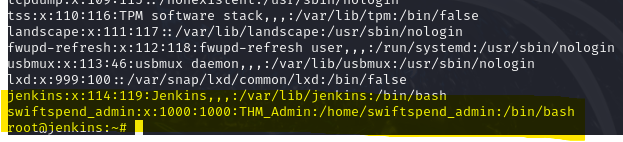
5.1 Which account gave the threat actors a foothold on the server?
Answer: swiftspend_admin
How to get this: cat /etc/passwd
5.2 What is the default password for the admin account of the Jenkins service?
Answer: f4fe137aeb154299ab1b7349952f6088
How to get this: The configuration files for Jenkins are stored in /var/lib/jenkins
In this case, go to /var/lib/jenkins/secrets and run the command cat initialAdminPassword

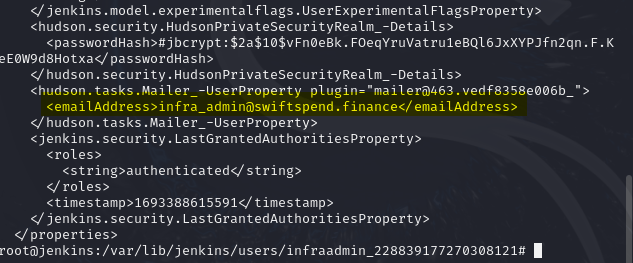
5.3 What is the email address of the other account within the Jenkins service?
Answer: infra_admin@swiftspend.finance
How do get this: User information is stored in /var/lib/jenkins/users. There are two user folders. Inside the folders is a config.xml. Run the command cat config.xml and we get:
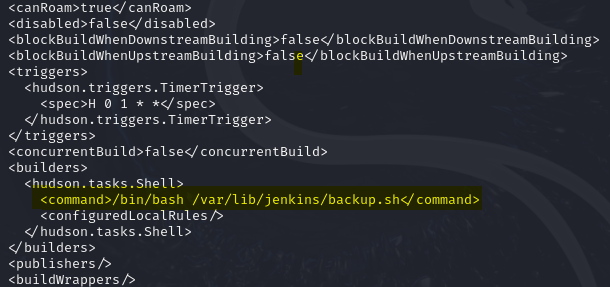
5.4 What is the command being invoked by the project found in the Jenkins dashboard?
Answer: /bin/bash /var/lib/jenkins/backup.sh
How do we get this:
The backup configuration is stored in: /bin/bash /var/lib/jenkins/backup.sh then run the command cat config.xml
5.5 How many times has the project been run before?
Answer: 0
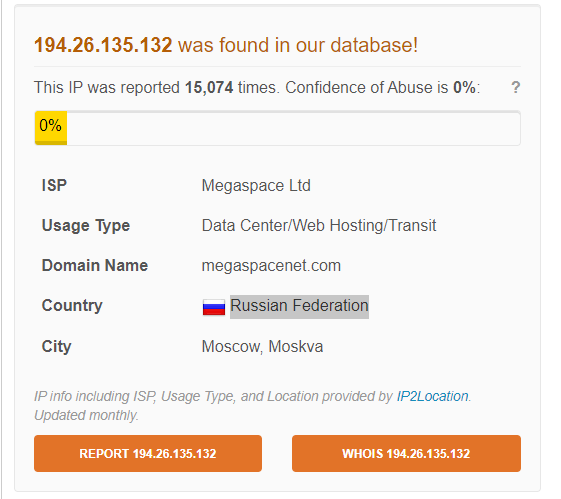
5.6 You will find a suspicious IP address. Which country is it hosted in? (Use AbuseIPDB; answer as written)
Answer: Russian Federation
How do we get this:
First we check the backup.sh script and find this:
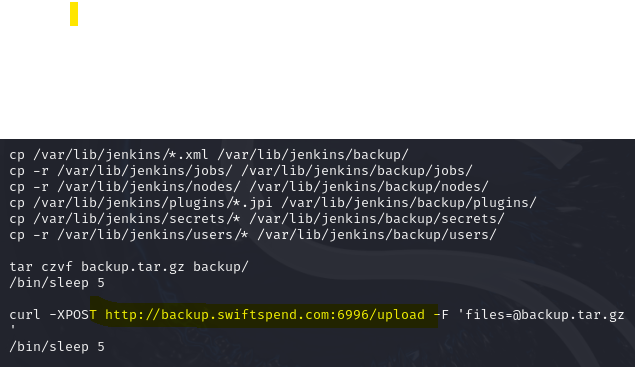
Checking the /etc/hosts file, we find this:
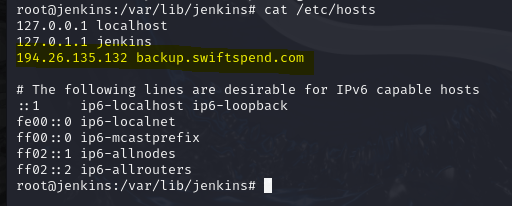
And by looking this IP address up in AbuseIP as instructed,
5.7 Based on the MITRE ATT&CK Matrix, which Tactic is being applied by the threat actor here?
Answer: Exfiltration
5.8 Based on the Lockheed Martin version of the cyber kill chain, in what phase is the threat actor already in on this server?
Answer: Actions on Objectives

