

The TryHackMe MAL: Researching Room explains what checksums are and how they can be used in Malware research as well as using online sandbox sites. The room is available at: https://tryhackme.com/room/malresearching
1.1 Name the term for an individual piece of binary
Answer: Bit
1.2 What are checksums also known as?
Answer: Hashes
1.3 What are checksums also known as?
Answer: SHA-512
1.4 According to this task, how long will you need to hash 6 million files before a MD5 hash collision occurs?
Answer: 100 Years
1.5 Who developed the MD5 algorithm?
Answer: Ronald Rivest
2.1 Name the key term for the type of malware that Emotet is classified as
Answer: Trojan
2.2 Research time! What type of emails does Emotet use as its payload?
Answer: spam emails
2.3 Begin analysing the report, what is the timestamp of when the analysis was made?
Answer: 9/16/2019, 13:54:48
2.4 Name the file that is detected as a “Network Trojan”
Answer: easywindow.exe
2.5 What is the PID of the first HTTP GET request?
Answer: 2748
2.6 What is the only DNS request that is made after the sample is executed?
Answer: blockchainjoblist.com
3.1 Using the HashTab tool, what is the MD5 checksum for “LoginForm.exe”?
Answer: FF395A6D528DC5724BCDE9C844A0EE89
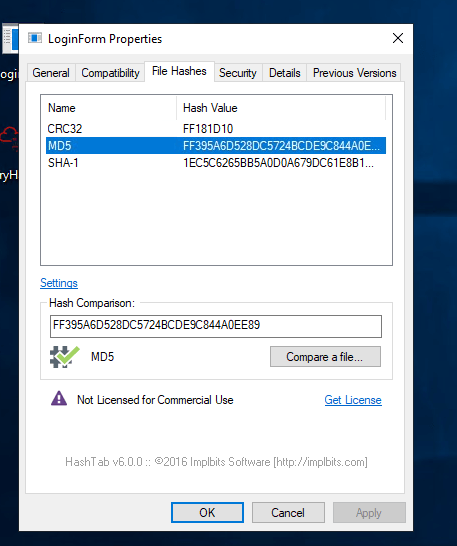
3.2 Using Get-FileHash in Powershell, retrieve the SHA256 of “TryHackMe.exe”
Answer: 6F870C80361062E8631282D31A16872835F7962222457730BC55676A61AD1EE0
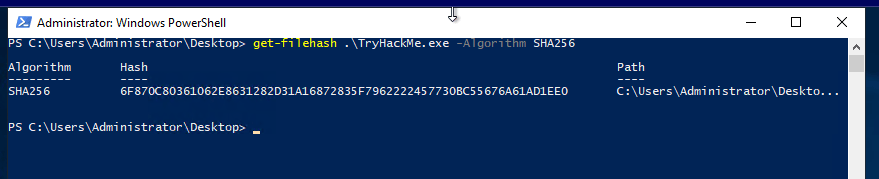
3.3 What would be the syntax to retrieve the SHA256 checksum of “TryHackMe.exe” using CertUtil in Powershell?
Answer: Certutil -hashfile TryHackMe.exe sha256

4.1 Navigate to the “Details” tab, what is the other filename and extension reported as present?
Answer: HxD.exe
4.2 In the same “Details” tab, what is the reported compilation timestamp?
Answer: 2020-02-28 11:16:36
4.3 What is the THM{} formatted flag on the report?
Answer: THM{TryHackMe_Malware_Series_Research_Flag}

