

The TryHackMe Securing the AI Supply Chain Room is a subscriber only room that shows how to inspect models, audit dependencies and govern LLM supply chains for a company. The room is available at: https://tryhackme.com/room/securing-the-ai-supplychain
1.1 What serialisation format was created by Hugging Face to replace pickle for ML models?
Answer: SafeTensors
1.2 What PyTorch parameter prevents code execution when loading pickle-based models?
Answer: weights_only=True
2.1 What is the first step in the Model Acquisition Framework when a new model is received?
Answer: Quarantine
2.2 Examine the checksums on the VM. Which model file does not match its expected hash?
Answer: model_review_v2.pkl

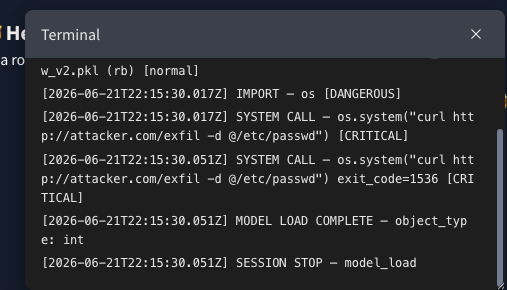
3. What object type does the compromised model’s telemetry show on load completion, instead of a model?
Answer: int
4.1 Which Trail of Bits tool performs static analysis of pickle files?
Answer: Fickling
4.2 What severity level does ModelScan assign to an os.system call in a model file?
Answer: CRITICAL

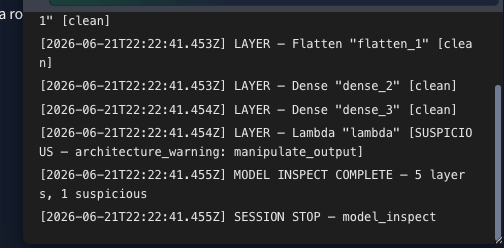
5. Open the Telemetry terminal. How many layers does the compromised model’s architecture contain?
Answer: 5
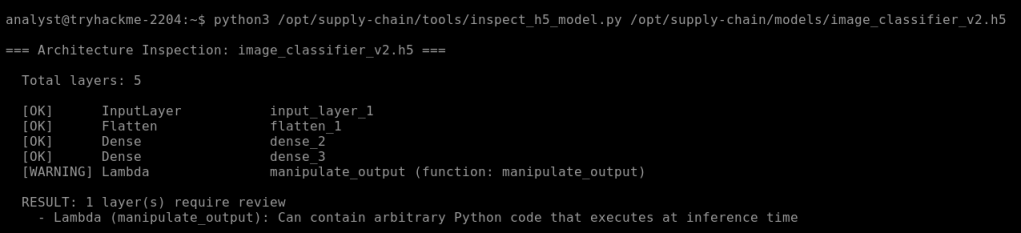
6. Run inspect_h5_model.py on image_classifier_v2.h5. What is the name of the suspicious Lambda layer?
Answer: manipulate_output
7.1 What is the recommended practice for specifying package versions in requirements.txt?
Answer: Version Pinning
7.2 What tool scans Python dependencies against known vulnerability databases?
Answer: pip-audit
7.3 Which SBOM format is maintained by OWASP and focuses on security?
Answer: CycloneDX
8.1 What should you establish to detect when an API provider silently updates their model?
Answer: Behavioural Baseline
8.2 What type of artefact should be version-controlled and reviewed like code, to prevent untrusted content from altering LLM behaviour?
Answer: System Prompts
8.3 What company name does Config B identify as the service provider?
Answer: TryTrainML


